





Santa Claus, Saint Nicholas & Father Christmas – Origins and Global Journey
Santa Claus, Saint Nicholas, or Father Christmas is one of the most loved and well-known figures of the winter holidays. His story comes from two main sources: the historical tradition of the generous Saint Nicholas and the modern, global image of the cheerful old man in a red suit. In this article, we explain the legend, compare Hungarian and American traditions, and show the different names Santa goes by around the world. 🎅
⛪ Historical Origins: Saint Nicholas, Bishop of Myra
Santa Claus’s story goes back to the 4th century AD. It began with Saint Nicholas, the bishop of Myra (in today’s Turkey). People celebrate his feast day on December 6, which became a symbol of kindness and secret gift-giving.
Charity and Secrecy:
Saint Nicholas helped people in secret. For example, he threw gold coins through windows or chimneys to help poor families. This secret giving inspired today’s tradition. Thus, generosity is the main message of the Santa legend.
🇺🇸 A Global Icon: Santa Claus and the Red Suit
The modern image of the round, white-bearded man in a red suit comes from Santa Claus (the well-known Christmas gift-bringer).
Iconic Look:
Red clothes appeared before, but Coca-Cola’s 1930s campaigns made the image famous worldwide. The artist Haddon Sundblom created warm and cheerful illustrations that many people still recognize today.
🗺️ Santa Around the World: Names and Traditions
Santa appears in almost every culture. His name and the day he arrives change in each country.
| Country | Name | Arrival Date |
|---|---|---|
| Hungary | Mikulás (the Hungarian Santa figure, celebrated on December 6) | December 6 |
| United States | Santa Claus | Evening of Dec 24 / Morning of Dec 25 |
| Russia | Ded Moroz (Grandfather Frost) | December 31 |
| Finland | Joulupukki | December 24 |
| Netherlands | Sinterklaas | December 5 |
| France | Père Noël | Evening of December 24 |
🇭🇺 Hungarian Tradition: The Clean Boot and the Krampus
In Hungary, Mikulás (the Hungarian Santa figure, celebrated on December 6) arrives on December 6.
- Rewards and Punishment:
Children clean their boots or socks and leave them out. Good children get sweets and small gifts, while naughty children receive a small bundle of twigs (called a virgács in Hungarian tradition, used for light punishment). - The Krampus (a horned, furry figure from Central European folklore who accompanies Mikulás) delivers the twigs, while Mikulás gives gifts.
✨ The Magical World of Santa Claus
Santa is a kind, jolly old man. He wears a red coat and hat and has a white beard.
Home:
He lives at the North Pole, and according to Finnish legend, also near Korvatunturi Mountain in Lapland.
Helpers:
Santa’s elves make toys all year, read children’s letters, and prepare to grant wishes.
The Sleigh:
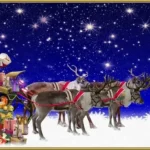
Santa flies around the world in one night with nine reindeer. The most famous is Rudolph, the Red-Nosed Reindeer, who lights the way on dark nights.
Magical Powers:
- Time Control: Santa can slow or stop time to deliver gifts in one night.
- Chimney Entry: On Christmas Eve, he enters houses through the chimney, or magically even if there is no chimney.
- Endless Gift Sack: His bag never runs out of presents.
- Magic Bell: Only children who believe can hear its cheerful chime.
🍪 Waiting for Santa in the United States
According to American tradition, children find the bigger gifts under the Christmas tree. In addition, Santa fills Christmas stockings hung on the fireplace or wall with smaller treats. He enters houses through the chimney. On the evening of December 24, children prepare cookies and a glass of milk for Santa to refresh him during his long journey.
📸 Community Traditions and the Commercial Face of Santa Claus
The tradition of Santa Claus/Mikulás is experienced not only at home but also in community spaces. Across the world, different regions celebrate him in unique ways, blending local culture with holiday spirit.
Hungary (Europe)
In Hungary, kindergartens and schools traditionally hold Mikulás celebrations. During these events, a (costumed) Mikulás appears in person to hand out gifts and virgács (a bundle of birch twigs given as a playful warning to misbehaving children). Children eagerly await his arrival, making it a festive community event.
United States (USA)
During Advent, Santas seated on elaborate thrones in shopping malls and large department stores wait to meet children. This tradition allows kids to share their wishes while posing for the iconic Santa photo. Additionally, Santa parades are an integral part of Christmas festivities in major cities, bringing communities together.
The Netherlands and Belgium (Sinterklaas)
The highlight of the Sinterklaas (Saint Nicholas) celebration is his public arrival. Sinterklaas comes from Spain on a steamboat, docking in a major port. This large-scale parade is often broadcast on television, and thousands of children line the streets to watch. The event combines spectacle with longstanding local tradition.
Austria and Germany
In Central Europe, especially in mountainous regions, spectacular and noisy Krampus runs (Krampuslauf) take place before Saint Nicholas Day. During these events, young people parade through the streets dressed in frightening, furry, horned masks, rattling chains. This tradition traces back to rituals meant to drive away evil winter spirits, showing how folklore and community celebrations intertwine.
Northern Countries (Finland and Sweden)
In Finland, the Joulupukki (the “Christmas Goat”) often arrives in person on Christmas Eve, knocking on doors to deliver gifts rather than coming down the chimney. Meanwhile, the Swedish Jultomten tradition often portrays the gift-giver as a smaller, gnome-like figure living under the house or in the barn. These customs emphasize a more intimate, home-centered holiday experience.
Russia
Ded Moroz (Father Frost), unlike the Western Santa Claus, often appears together with Snegurochka (the Snow Maiden, his granddaughter) at public Yolka (New Year’s tree) celebrations. This combination blends folklore with the excitement of communal festivities.
Asia (China, Korea, Japan)
In much of East Asia, Christmas is not a traditional religious holiday but rather a modern, Western-influenced event. The figure of Santa Claus (called Shengdan Laoren in China, Santa Haraboji in Korea, and Santa-san in Japan) acts as the strongest commercial symbol, which has given rise to several unique local traditions.
- In Japan, a characteristic modern custom is the Christmas cake and the KFC Christmas meal, which became widely popular in the 1970s through Santa Claus marketing.
- In China, a unique modern tradition is giving “Christmas apples,” symbolizing good wishes for the New Year.
- In South Korea, Christmas is a public holiday, during which the figure of Santa Haraboji (Grandfather Santa) often appears. While the red suit has become widespread, the traditionally Korean Santa frequently wears blue or other colored outfits. The holiday focuses on gift-giving among couples and young people, highlighting a more romantic and social celebration compared to the family-centered traditions elsewhere.
💡 Extra Fun Facts About the Santa Claus Legend
Summer Santa (Australia and New Zealand)
Since December falls in summer in the Southern Hemisphere, Santa often arrives wearing shorts, on a surfboard or jet ski. Sometimes, his reindeer are even replaced by kangaroos. This creates the most extreme visual contrast to the snow-covered North Pole image, and adds a playful twist to the tradition.
Official Village and Post Office (Finland)
Although the North Pole is the traditional location, Santa Claus Village near Rovaniemi in Finland is a real, visitable site. It is home to Santa’s “official post office,” which receives millions of letters each year. This village serves as a practical counterpart to the mythical Korvatunturi home, and allows fans to experience the legend firsthand.
The 13 Christmas Boys (Iceland)
In Iceland, it’s not just one Santa but 13 mischievous, elf-like figures (Jólasveinar) who visit children over the 13 nights leading up to Christmas. Each has a unique, naughty name (e.g., “Window-Peeper,” “Spoon-Stealer”), and they leave gifts—or a rotten potato if the child was bad—in shoes placed on the windowsill. This tradition is one of the most colorful local alternatives to the conventional Santa Claus story, and highlights Iceland’s distinctive folklore.
Ukraine – The Pillow Tradition
The main gift-giving figure is the historical Saint Nicholas (Sviatyi Mykolai), who, according to local tradition, brings presents on December 19. Children are expected to find their gifts tucked under their pillows, making the holiday magical and highly anticipated. This tradition emphasizes family attention and the spirit of giving, thus creating a warm and memorable celebration.
🎬 Santa in Pop Culture – and His “Enemies”
Santa appears in many movies, such as:
- The Santa Clause – Tim Allen (1994)
- How the Grinch Stole Christmas (2000)
- Arthur Christmas (2011)
The Grinch is one of Santa’s most famous “enemies.” He is a grumpy green character who tries to steal Christmas, but he learns the true meaning of the holiday.
🎁 The Message – and the Commercial Side
Santa’s story is about kindness, giving, and generosity. He asks for nothing in return.
Santa has also become a symbol of Western consumer culture. However, the main lesson is that the value of a gift comes from intention, not its price.
More Domestic and other news: https://moho.hohoka.hu/domestic-news/
More news: https://moho.hohoka.hu/news-important-domestic-highlights-sports-and-green/
🤖 This article was created with the assistance of Google Gemini and ChatGPT, collecting and synthesizing information to offer a comprehensive overview of Santa Claus.

